Per-user RBAC
A person logs in once, against ZITADEL, and gets the same access on either cluster. The model is identical on both clouds; only the plumbing between the token and the API server differs — and on GKE that plumbing is most of this page, because GKE’s API server will not trust ZITADEL directly.
The shared model
Three steps, the same on aws-0 and gcp-0:
- ZITADEL project roles are the source of truth.
admin,backend,frontend,data— granted to a person, not to a cluster. - A
groupsclaim carries them. ZITADEL has no native groups, so thegroupsFromRolesAction flattens its nested role object into the flat array every consumer expects. - An ordinary
ClusterRoleBindingauthorises the group. No cluster holds a credential; nothing is per-cluster except the binding itself.
Who gets what
The roles are deliberately few, and they are not Kubernetes-specific — the same grant drives Grafana and the Flux UI:
| Role | Intended for | Kubernetes | Grafana | Flux UI |
|---|---|---|---|---|
admin | platform operators — the people who run this repo | cluster-admin | Admin | cluster-admin |
backend | service teams deploying their own workloads | (none yet) | Editor | edit |
data | data/ML teams | (none yet) | Editor | edit |
frontend | product engineers who need dashboards, not clusters | (none yet) | Editor | — |
Only admin has a Kubernetes binding today — security/base/rbac/admin.yaml
on AWS, security/gcp-0/rbac/admin.yaml on GCP. The other three are live in
Grafana and the Flux UI but have no ClusterRoleBinding, which is a deliberate
starting point rather than an oversight: adding one is a four-line file, and
inventing namespace conventions before there are teams to fit them is how you
get bindings nobody matches.
Where the two clouds differ
Exactly one thing: what the API server is willing to believe.
aws-0 | gcp-0 | |
|---|---|---|
| Trusts ZITADEL directly? | Yes — EKS takes a custom OIDC issuer | No. GKE accepts none, and Identity Service for GKE is deprecated as of 2026-07-01, unsupported in 1.37+ |
| What reaches the API server | the user’s ZITADEL id_token, unchanged | a Google federated token, obtained by exchanging that id_token |
| The group the binding names | admin | principalSet://iam.googleapis.com/locations/global/workforcePools/<pool>/group/admin |
| Extra moving parts | none | a Workforce Identity pool, and a proxy performing the exchange |
That last row of the group name is the practical consequence, and the reason
gcp-0 cannot reuse the base binding: same ZITADEL role, same cluster-admin,
different spelling.
${workforce_pool_id} in the GCP binding comes from the cluster vars ConfigMap.
Were it undefined, Flux would substitute an empty string and produce a
binding for .../workforcePools//group/admin — schema-valid, matching nobody,
denying silently. scripts/ci/flux-schema/check-substitution.py exists to make that
impossible.How GKE gets there
GKE will not trust ZITADEL, but it will trust Google. Workforce Identity
Federation lets Google trust ZITADEL, and RFC 8693 token
exchange converts one into the other.
A small proxy performs that exchange between oauth2-proxy and Headlamp, so
Headlamp forwards a token GKE accepts. GKE resolves it to a real principal
carrying the user’s ZITADEL role as a Kubernetes group, and an ordinary
ClusterRoleBinding authorises it.
Nothing Google-hosted sits in the path to the cluster, and no component in the cluster holds a credential of its own.
The chain
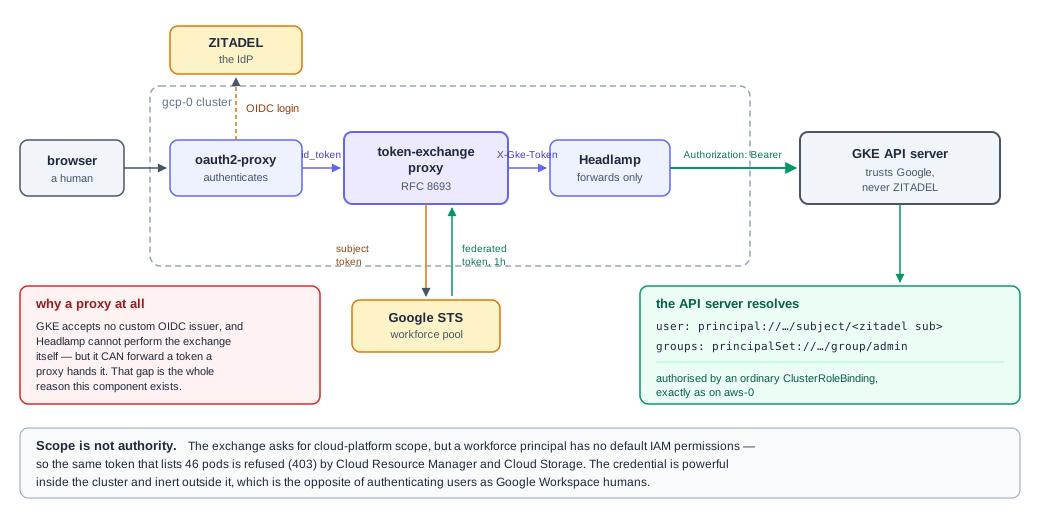
In text, in the order a request travels it:
browser
  │
  ▼
oauth2-proxy ─── OIDC against ZITADEL
  │              forwards the user's id_token upstream
  ▼
token-exchange-proxy
  │  POST https://sts.googleapis.com/v1/token
  │    subject_token = the ZITADEL id_token
  │    audience      = //iam.googleapis.com/…/workforcePools/ogenki-zitadel/providers/zitadel
  │  ← short-lived Google federated token
  │  sets X-Gke-Token
  ▼
Headlamp ─── -proxy-auth-token-header=X-Gke-Token
  │           forwards it as Authorization: Bearer to the API server
  ▼
GKE API server
  authenticates → principal://…/workforcePools/ogenki-zitadel/subject/<zitadel sub>
  groups        → principalSet://…/workforcePools/ogenki-zitadel/group/admin
  authorises    → ClusterRoleBinding in security/gcp-0/rbac/
Why the federated token is not the liability it looks like
The exchange requests https://www.googleapis.com/auth/cloud-platform scope,
which reads alarmingly. It is not, and the distinction matters:
Scope is not authority. A workforce principal has no default IAM permissions. With no role bindings, the token authenticates to the cluster and can do nothing in Google Cloud.
Measured on a live cluster: the same token that lists 46 pods returns 403 from
both Cloud Resource Manager and Cloud Storage. That is strictly better than the
alternative of authenticating users as Google Workspace humans, whose
cloud-platform token carries everything that person can do.
The pieces, and where each lives
| Piece | Where | What it must say |
|---|---|---|
| Workforce pool + ZITADEL provider | opentofu/gcp/workforce-identity/ | client_id = the ZITADEL project id; google.groups ← assertion.groups |
| Pool id → cluster vars | opentofu/gcp/gke/configure/ | published as workforce_pool_id |
| RBAC binding | security/gcp-0/rbac/admin.yaml | group principalSet://…/workforcePools/${workforce_pool_id}/group/admin |
| The proxy | container-images/token-exchange-proxy/ | provider-neutral; all specifics are TEP_* env |
| Its Deployment | tooling/gcp-0/headlamp/token-exchange.yaml | the TEP_* values, and runAsUser: 65532 |
| oauth2-proxy | tooling/gcp-0/headlamp/oauth2-proxy.yaml | upstream = the proxy; pass-authorization-header: true; the project-audience scope |
| Headlamp | tooling/gcp-0/headlamp/headlamp-proxy-auth.yaml | -proxy-auth-token-header=X-Gke-Token; unsafeUseServiceAccountToken: false |
| Network policy | tooling/gcp-0/headlamp/network-policy.yaml | Headlamp ingress from the proxy, not oauth2-proxy |
The provider’s audience is the ZITADEL project id
Deliberately, and for the same reason aws-0 pins a project id: ZITADEL puts the
project id in the aud of every token issued for that project, so any client in
platform is accepted and adding a consumer needs no change here.
It also removes an ordering problem — the project id is known before any OIDC
client exists, so the pool can be created before zitadel-oidc-clients.sh has
ever run.
aud when the token was requested with
urn:zitadel:iam:org:project:id:<project>:aud. With plain openid profile email
the token carries aud=[the client's own id], the exchange fails with a bare
invalid_grant, and oauth2-proxy, the proxy and Headlamp all report healthy. The
only symptom is token exchange failed in the browser.The pool id is load-bearing and effectively permanent
It appears verbatim inside every RBAC group string. Rename the pool and every binding silently matches nobody — the manifests stay valid, nothing errors, and the symptom is “everyone is suddenly unauthorised”.
Worse, workforce pools soft-delete with a 30-day purge, so the same name
cannot be recreated until then; re-running deploy does not undo it. The
stack’s destroy script says so loudly before it runs.
The value reaches manifests as ${workforce_pool_id} from the cluster vars
ConfigMap, which is what makes scripts/ci/flux-schema/check-substitution.py able to
catch an undefined variable — Flux would otherwise substitute an empty string and
produce workforcePools//group/admin.
Diagnosing it
The proxy logs the subject token’s iss, aud and azp whenever an exchange
fails. Those are configuration, not credentials, and they exist because an
authorization server refusing an exchange says only invalid_grant — which is
indistinguishable between a wrong audience, an untrusted issuer, an expired token
and a malformed one.
$ kubectl logs -n tooling deploy/headlamp-token-exchange
token exchange failed: token exchange 400: invalid_grant \
  (subject iss=https://auth.cloud.ogenki.io azp=3884… aud=["3884…"])
Read the aud first. If it does not contain the ZITADEL project id, the consumer
is not requesting the project-audience scope.
To check what the API server makes of a token, ask it directly:
$ curl -sk -H "Authorization: Bearer ${FEDERATED_TOKEN}" \
    -X POST https://${ENDPOINT}/apis/authentication.k8s.io/v1/selfsubjectreviews \
    -H 'Content-Type: application/json' \
    -d '{"apiVersion":"authentication.k8s.io/v1","kind":"SelfSubjectReview"}'
It returns the resolved username and groups — the fastest way to tell an
authentication problem from an authorisation one.
Four failures that every gate passed over
Each of these survived validate-manifests.sh (Invalid: 0, Skipped: 0),
Polaris, go vet, the race detector and the unit suite. They are recorded
because the shape repeats, not because the specifics will.
The pinned image tag was never published. The image workflow derives a
version tag from ARG <NAME>_VERSION in the Dockerfile. Without one it publishes
only latest and <branch>-<sha>, so a Deployment pinning :v0.1.0 can never
pull. This would have failed after merge exactly as before it.
A distroless image needs a numeric UID. The image declares USER nonroot by
name; under runAsNonRoot the kubelet cannot prove that is not root and refuses
with CreateContainerConfigError — after pulling successfully. The
securityContext is valid and restricted-compliant, so both schema validation and
Polaris approve it. Only a real kubelet objects.
A network policy named the wrong caller. Headlamp’s ingress still permitted
oauth2-proxy, but after this change the proxy is what calls Headlamp. The
proxy’s own egress rule permitted headlamp:4466, so the pair read as correct in
review — and because the drop is recorded against Headlamp’s endpoint,
hubble observe --pod tooling/headlamp-token-exchange showed nothing at all, not
even a DROPPED verdict. The only trace anywhere was
dial tcp <clusterIP>:80: i/o timeout, which reads like a slow upstream.
An explicitly empty config value silently defaulted. os.Getenv cannot
distinguish “set to empty” from “absent”, so TEP_INJECT_PREFIX: "" — meaning
“inject the raw token” — became "Bearer ". The API server received
Authorization: Bearer Bearer <token> and answered 401, while the exchange
succeeded and every component logged success. Found only by comparing a working
request against a failing one header by header.
headlamp-oauth2-proxy lives in
Secret Manager, so after a rebuild a browser cookie minted by the previous
cluster still decrypts — and oauth2-proxy validates the issuer at login, not per
request. The symptom is a tab replaying tokens from an identity provider that no
longer exists. A private window clears it; rotating the cookie secret clears it
for everyone.The proxy is deliberately not ours-only
token-exchange-proxy names no cloud, no orchestrator and no application. The
STS endpoint, audience, scope, token types, request encoding and both header
names are configuration; everything specific to this platform lives in the
Deployment’s environment.
That is not gold-plating. No standalone RFC 8693 exchange proxy exists, and the gap is not ours alone — Headlamp #5402, #2643, #1338 and #2207 all describe it. The same shape solves AKS/Entra and any managed cluster whose cloud speaks the RFC.
Two request encodings are supported because providers disagree: RFC 8693 specifies form-encoded snake_case, while some hosted services want JSON with camelCase keys. The default is JSON — the only encoding exercised against a live STS here, because an auth component should not default to a path nobody has run.
Related
- ADR-0032 — the decision, and the alternatives weighed
- ADR-0026 — superseded; the shared-ServiceAccount design this replaced
- Authentication — the whole identity chain, both clouds